How to Be a Stoic by Massimo Pigliucci
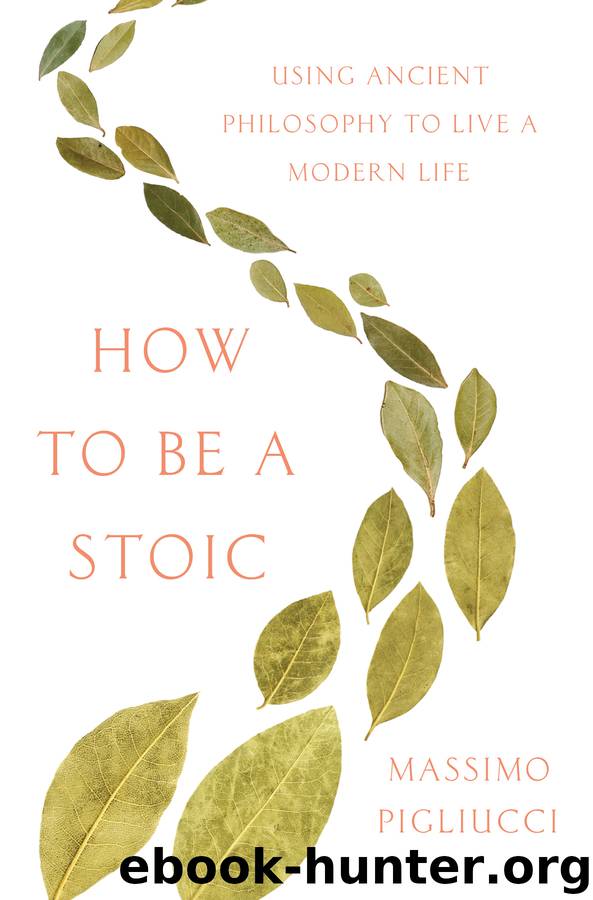
Author:Massimo Pigliucci
Language: eng
Format: epub, azw3, mobi
Publisher: Basic Books
Published: 2017-05-08T16:00:00+00:00
PART III
THE DISCIPLINE OF ASSENT: HOW TO REACT TO SITUATIONS
CHAPTER 11
ON DEATH AND SUICIDE
I must die, must I? If at once, then I am dying: if soon, I dine now, as it is time for dinner, and afterwards when the time comes I will die.
—EPICTETUS, DISCOURSES, I.1
THE ANCIENT STOICS WERE VERY CONCERNED WITH DEATH. Actually, “concerned” is precisely the wrong word. They were aware of death and of the importance that human beings attach to it, but they developed a very unusual and empowering view of it.
I must confess that I’ve had long and hard conversations with Epictetus about this topic: the thought of death used to bother me deeply. Indeed, there was a time in my life when I was thinking about it almost every day, and on some days more than once. I don’t want you to get the impression that I was ever the brooding type, prone to depressive thoughts. On the contrary, I’ve always been reasonably optimistic about life, enjoying or doing my best with whatever Fortune sends my way (and she has sent a lot, thankfully). Moreover, I am a biologist. I know that death is a natural occurrence, the result of the particular evolutionary pathway taken by our ancestors eons ago. (If we were bacteria, for instance, we wouldn’t die of old age, only of accidents; then again, we wouldn’t be able to develop philosophies of life either.) Still, the thought of my consciousness one day ceasing to exist did upset me. Things started to change when I first read Epictetus’s statement at the beginning of this chapter. I laughed out loud and thought, What an unbelievably lighthearted attitude toward what most people think is the most dreadful thing of all.
Epictetus also explained to me why I was so bothered: “Why does an as of wheat grow? Is it not that it may ripen in the sun? And if it is ripened is it not that it may be reaped, for it is not a thing apart? If it had feelings then, ought it to pray never to be reaped at any time? But this is a curse upon wheat—to pray that it should never be reaped. In like manner know that you are cursing men when you pray for them not to die: it is like a prayer not to be ripened, not to be reaped. But we men, being creatures whose fate it is to be reaped, are also made aware of this very fact, that we are destined for reaping, and so we are angry; for we do not know who we are, nor have we studied human things as those who are skilled in horses study the concerns of horses.”
This is an intriguing passage. Epictetus sets forth three interlinked ideas. To begin with, we are no different from other living beings: like the wheat whose as are destined to ripen in the sun, we too are destined for “reaping.” The Stoics took destiny more literally than many of us do today, since they believed in some sort of cosmic Providence.
Download
How to Be a Stoic by Massimo Pigliucci.azw3
How to Be a Stoic by Massimo Pigliucci.mobi
This site does not store any files on its server. We only index and link to content provided by other sites. Please contact the content providers to delete copyright contents if any and email us, we'll remove relevant links or contents immediately.
| Anthropology | Archaeology |
| Philosophy | Politics & Government |
| Social Sciences | Sociology |
| Women's Studies |
The remains of the day by Kazuo Ishiguro(9006)
Tools of Titans by Timothy Ferriss(8404)
Giovanni's Room by James Baldwin(7356)
The Black Swan by Nassim Nicholas Taleb(7137)
Inner Engineering: A Yogi's Guide to Joy by Sadhguru(6801)
The Way of Zen by Alan W. Watts(6621)
The Power of Now: A Guide to Spiritual Enlightenment by Eckhart Tolle(5791)
Asking the Right Questions: A Guide to Critical Thinking by M. Neil Browne & Stuart M. Keeley(5779)
The Six Wives Of Henry VIII (WOMEN IN HISTORY) by Fraser Antonia(5520)
Astrophysics for People in a Hurry by Neil DeGrasse Tyson(5196)
Housekeeping by Marilynne Robinson(4456)
12 Rules for Life by Jordan B. Peterson(4315)
Ikigai by Héctor García & Francesc Miralles(4280)
Double Down (Diary of a Wimpy Kid Book 11) by Jeff Kinney(4278)
The Ethical Slut by Janet W. Hardy(4264)
Skin in the Game by Nassim Nicholas Taleb(4258)
The Art of Happiness by The Dalai Lama(4133)
Skin in the Game: Hidden Asymmetries in Daily Life by Nassim Nicholas Taleb(4013)
Walking by Henry David Thoreau(3970)
